Continuous ultrasound-based human presence verification for AI agent detection. Using only a device's built-in speaker and microphone to emit inaudible ultrasound probes, EchoGuard analyzes reflected acoustic responses to distinguish real users from automated agents in real time.
AI agents can now mimic legitimate user behavior at scale — completing transactions, scraping data, and abusing promotions while appearing human. Existing defenses like CAPTCHAs are one-time checks that leave a critical gap after authentication. EchoGuard fills this gap with continuous, real-time human-presence verification.
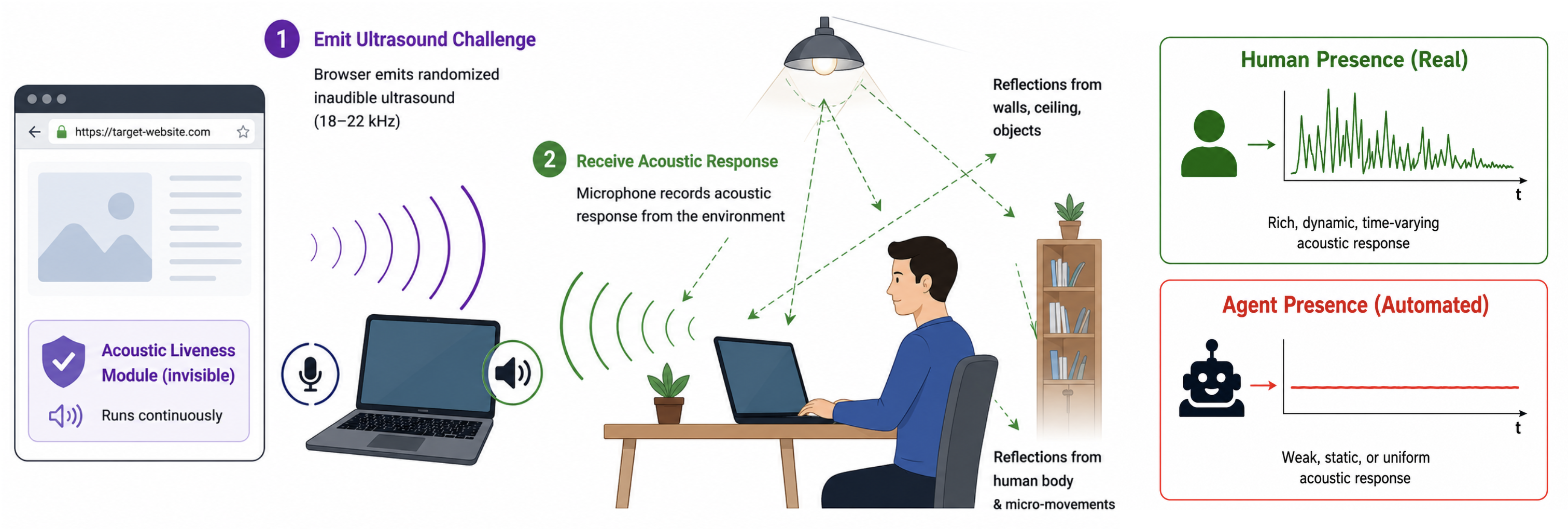
The browser emits inaudible ultrasound (18–24 kHz) via the device speaker. An invisible acoustic liveness module runs continuously.
The microphone records reflections from the user's body and surroundings. Human micro-movements produce rich, time-varying signatures.
Real humans generate dynamic, fluctuating reflections. Agents produce weak, static responses — enabling clear discrimination.
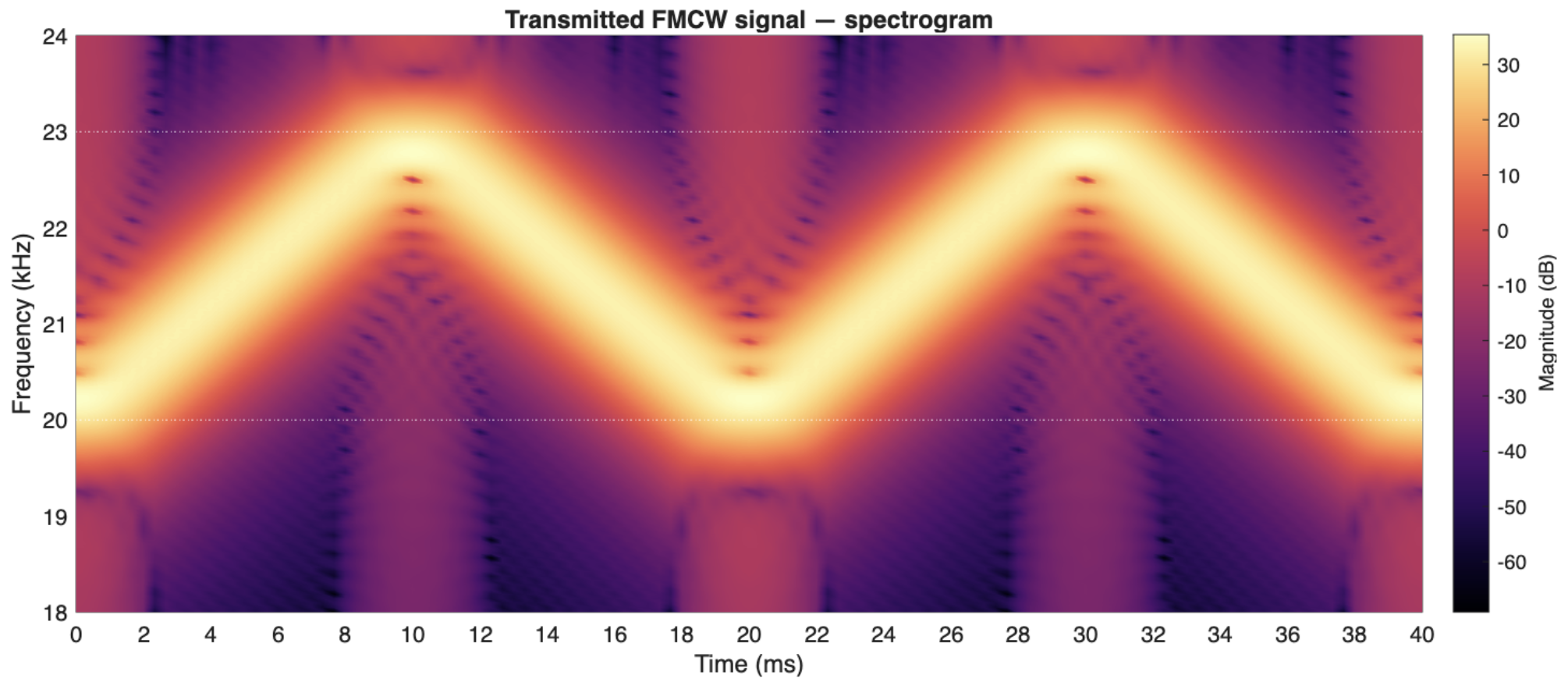
EchoGuard uses an FMCW sensing pipeline to transform raw ultrasonic reflections into amplitude-phase trajectories that reveal human presence.
Transmitted FMCW Signal. Spectrogram of the 20–24 kHz sweep; chirps repeat at ~10 ms intervals.
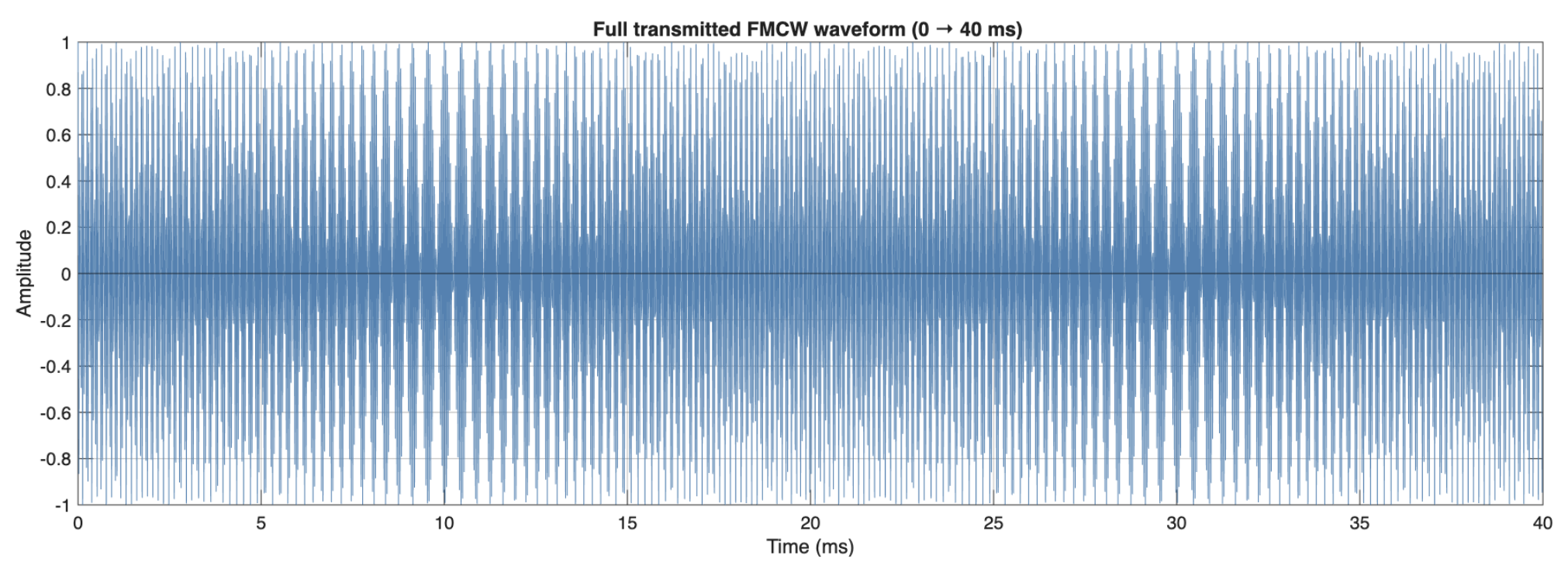
Transmitted Waveform. Time-domain view of the FMCW chirp signal.
We evaluate EchoGuard under multiple scenarios — from baseline agent-only settings to adaptive attacks where a human is present alongside the agent to confound detection.
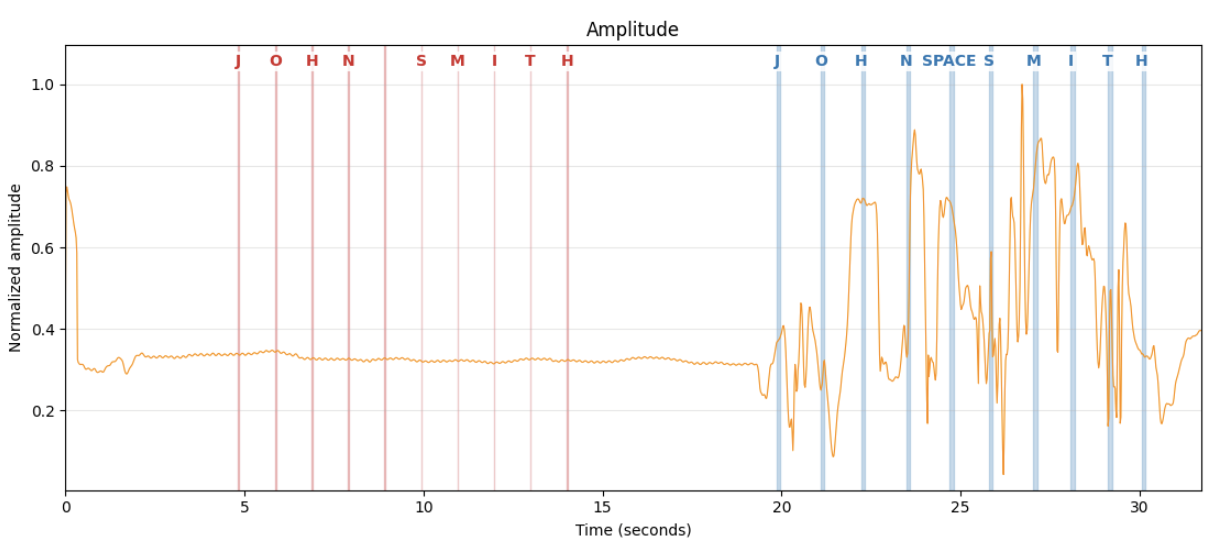
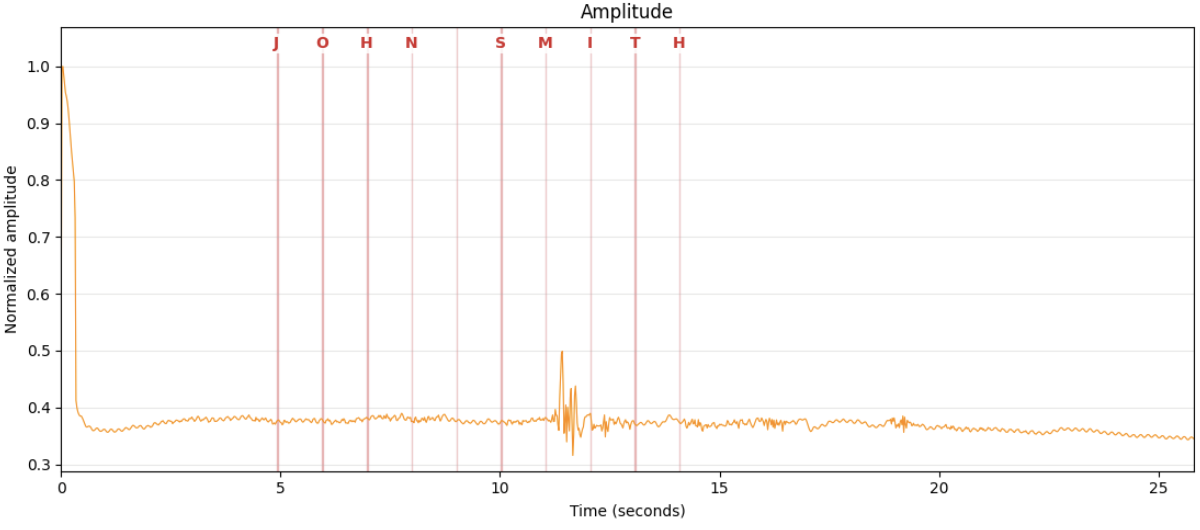
Single-session protocol on a commodity laptop. First 5 s idle, then agent
(OpenClaw) types "John Smith" with 1 s gaps
J→o→h→n→ →S→m→i→t→h,
followed by 5 s idle, then a human types the same string for direct comparison.
Agent (OpenClaw) types "John Smith" (red markers) producing flat amplitude. Human types the same string (blue markers) with rich, dynamic fluctuations from natural hand and body micro-movements.
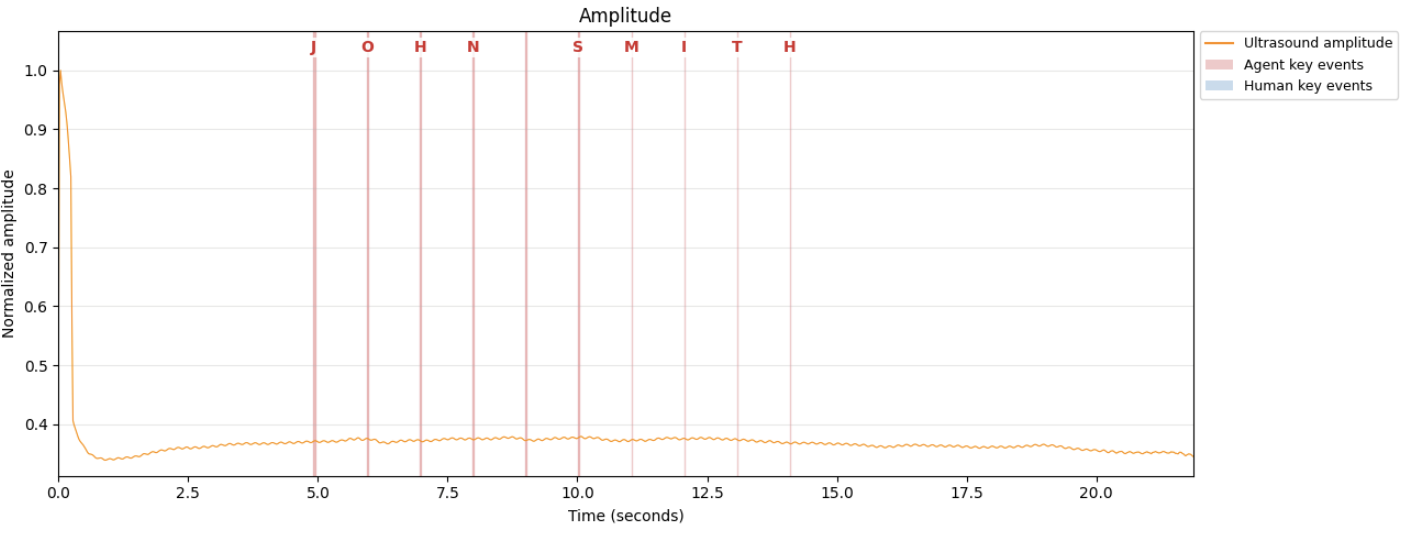
The agent (OpenClaw) operates the device with no human nearby. Ultrasound amplitude stays flat — agent keystrokes (red) produce no perceptible change, confirming software-only interaction lacks physical signatures.
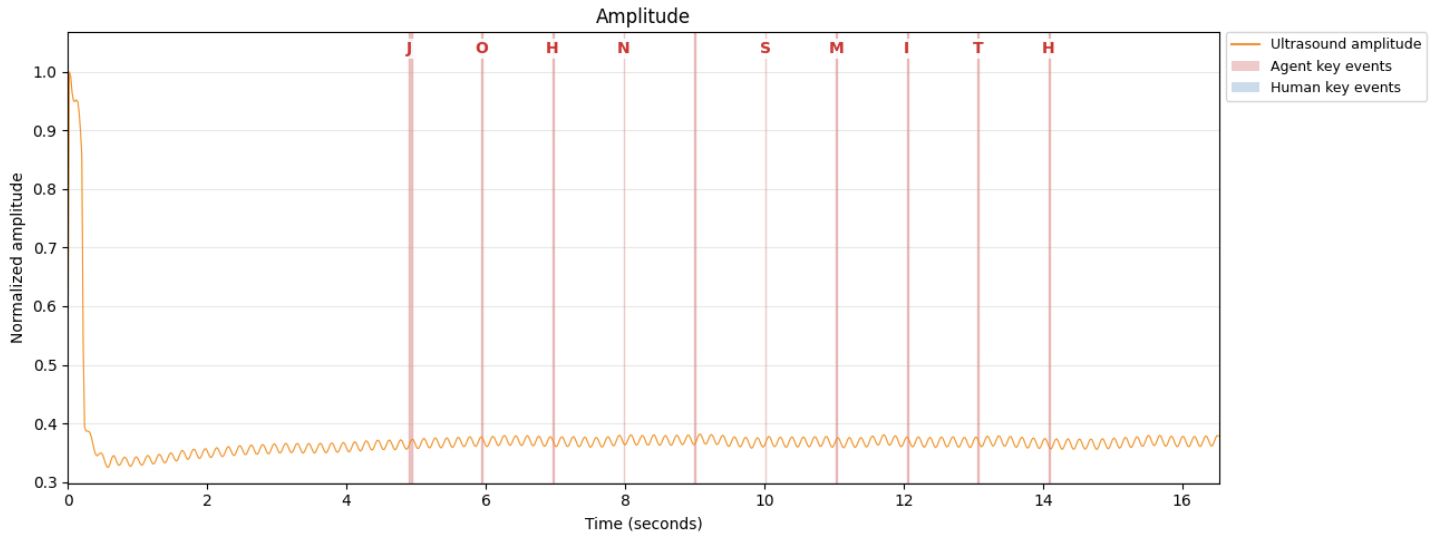
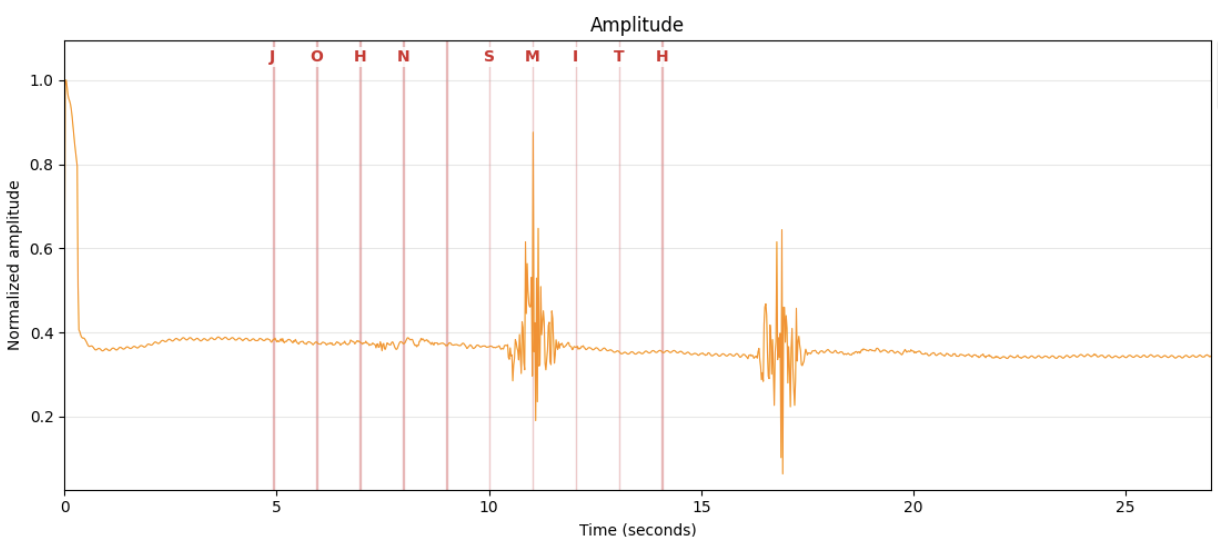
Human sits still while agent types. Subtle ripple patterns from involuntary micro-movements (breathing, posture) are detectable and distinct from agent-only baseline.
Human moves around the laptop during agent typing. Movement introduces amplitude spikes that test separation of motion artifacts from genuine interaction.
Periodic hand gestures near the laptop during agent typing produce large, intermittent amplitude excursions — clearly distinguishable from flat agent traces.
PI — Indiana University Bloomington
Assistant Professor, CS. Expert in AI security, web-agent threats, and acoustic sensing. Best Paper at SenSys '21, Honorable Mention at CCS '22. Former Amazon Applied Scientist.
Co-PI — Univ. of Maryland, Baltimore County
Assistant Professor, CSEE. Smartphone acoustic sensing, gesture tracking, Doppler-based mobile sensing. 2025 Google Research Scholar Award.